How a Restaurant or Café Runs Its Entire Business on VexaOS
Not a tour of features — a day. One full service, open to close, at a café + kitchen we'll call Ember & Oak — seen from four sides of the same connected system: the guest, the server, the kitchen line, and the owner.
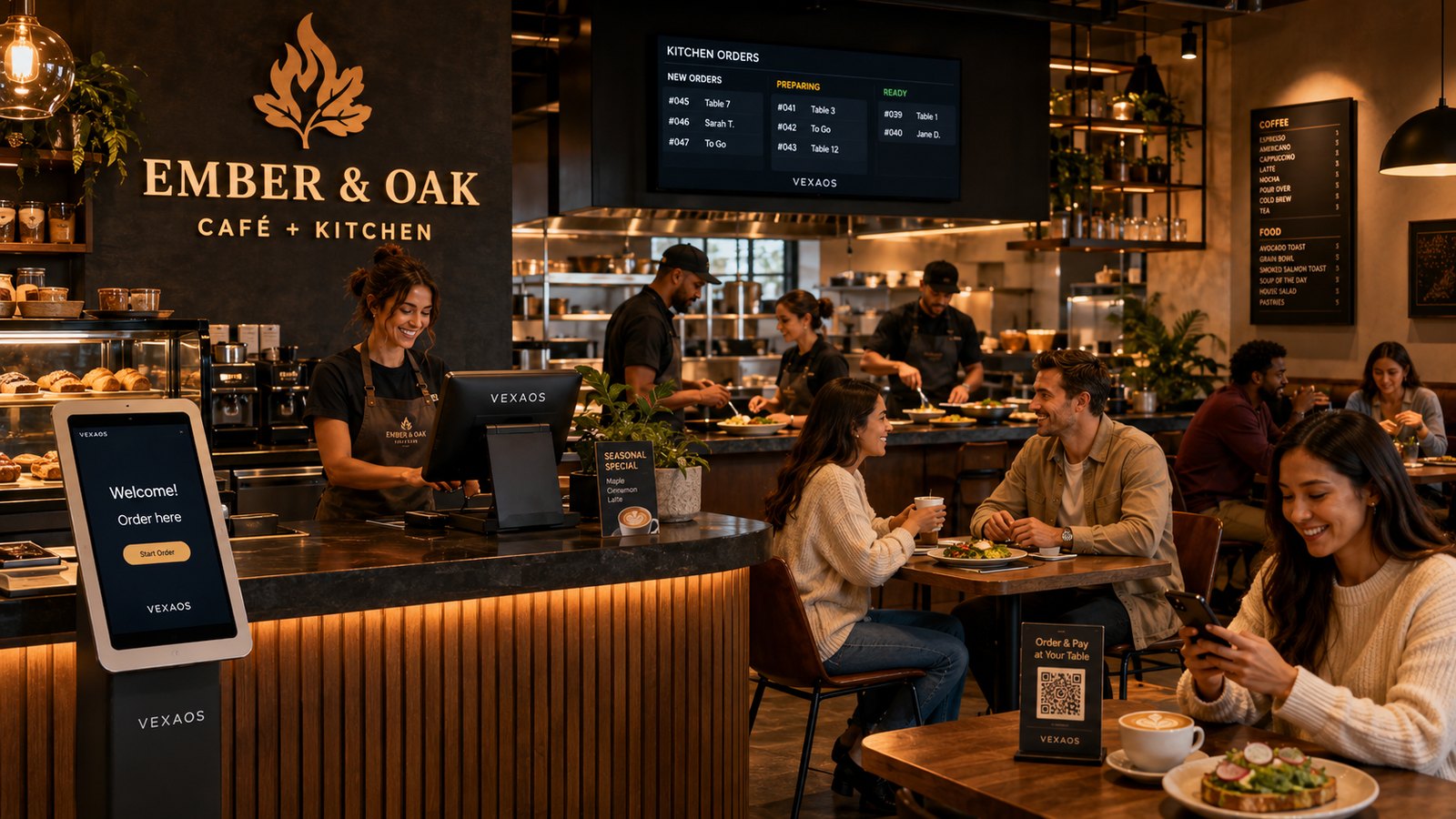
A restaurant is the hardest kind of software problem there is, disguised as a plate of food. Dozens of orders are alive at once. Every one has a different clock — a flat white takes ninety seconds, a brunch board takes nine minutes, and they have to land on the same table at the same time. The dining room, the pass, the kitchen, the card reader, the delivery apps, and the walk-in fridge all need to agree about reality, constantly, while it's loud and everyone is moving.
Most kitchens hold that together with a drawer full of disconnected tools: one tablet for the delivery app, another for the second delivery app, a register that doesn't know what the kitchen is doing, a clipboard on the walk-in door, and a printer spitting tickets that are wrong the moment something sells out. Every device is an island. The staff is the integration — retyping, shouting across the pass, and hoping.
VexaOS replaces the drawer of tablets with one connected system. The site a guest orders from, the QR code on the table, the kiosk by the door, the handheld in the server's apron, the screen on the line, the scale in the stockroom, and the dashboard on the owner's phone are not separate products stitched together. They are one operating system, reading and writing to a single live source of truth, updating everywhere the instant anything changes.
The best way to feel that isn't a feature list. It's a day. So let's work one — from the first flat white to the final reconciliation — and watch the same moment from every side of the pass.
Before the doors open, the day is already legible
Nadia owns Ember & Oak. She used to arrive to a paper puzzle: how did yesterday actually do, is anyone calling out, did the produce order go in, are we about to run out of oat milk on the busiest morning of the week. On VexaOS, she opens one screen and the whole restaurant is already legible — last night reconciled itself, today is laid out, and the kitchen knows what it has before the first cook ties an apron.
Yesterday, already closed
Net sales, covers, average check, comps, voids, and tips — reconciled overnight because every order and every payment already lived in the same system. No morning spent rebuilding numbers from a Z-report and a stack of delivery emails.
Labor laid against the forecast
Today's schedule sits next to today's projected covers, so Nadia can see she's one server heavy at 2pm and light on the line at the 6pm rush — and fix it before it costs her.
Par levels checked overnight
The system already compared last night's counts to par and flagged what's short. Oat milk, cold-brew concentrate, and brioche buns are low; the reorder is drafted and waiting for a tap.
The menu, primed for the day
Weekend brunch is live, the two sold-out specials from last night are already hidden, and today's feature — a peach-and-burrata toast — is scheduled to appear at open across every channel at once.
None of this is a report she ran. It's just the state of the restaurant, waiting for her. The day hasn't started and she's already ahead of it.
The first order arrives before anyone unlocks the door
Across town, a regular named Theo is still on his couch. He opens the Ember & Oak app — the café's own brand on his home screen, not a third-party marketplace that owns the relationship and rents it back. He orders his usual oat flat white and a peach toast for pickup at 8:15, pays with his saved card, and watches the order move from Received to Making to Ready in real time. He never called, never waited on hold, never stood in a line.
The digital menu he ordered from is doing far more than listing prices. It's the same menu the kitchen, the kiosk, and the QR codes all read from — so it is never out of date, never contradicting itself between channels.
A menu that sells and informs
Real photography, clear pricing, and honest descriptions — plus modifiers that actually match the kitchen's reality: oat, almond, or whole; single or double; add avocado. Every option maps to a real recipe and a real cost.
Allergens & dietary, built in
Gluten-free, vegan, nut-free, and allergen flags live on each item, so a guest with a real restriction can order with confidence instead of a hopeful guess — and the kitchen sees the same flags on the ticket.
Pickup & delivery, tracked live
One flow for pickup and delivery, with live status and an accurate ready-time the guest can actually trust — because the clock comes from the kitchen's real load, not a fixed guess.
Loyalty that remembers him
Points post automatically, a free-drink reward is two visits away, and his usual order is one tap to reorder. The relationship compounds instead of resetting every time.
For Theo it feels effortless. What he can't see is that his order didn't land in an inbox someone has to watch. It went straight onto the same live thread the whole restaurant runs on — and it's already on the kitchen's screen.
Theo taps “Place order” at 7:55 — and in the same instant, across the whole system:
- The ticket appears on the Kitchen Display, routed to the espresso and cold stations, timed to be ready at 8:15.
- His oat milk, espresso, and brioche are decremented from inventory the moment the item is made.
- Loyalty points are reserved to his account and his ready-time estimate starts ticking.
- The sale posts to the owner dashboard as pre-open pickup revenue — no re-entry, no reconciliation later.
A full room, and nobody stuck waiting to order
By late morning the room is full and the door is busy. This is where most cafés bottleneck — one register, one line, and every guest funneling through it. Ember & Oak doesn't have one front door into the system; it has several, and they all write to the same place.
Order from the table
A couple takes a window seat, scans the QR code on the table, and the café's real menu opens on their phones — tied to that exact table number.
- They browse with photos, allergens, and modifiers and order at their own pace
- The order lands on the kitchen screen tagged to Table 12 — no server relay needed
- They add a second round of coffees later without flagging anyone down
- They pay from the phone when ready, or leave it on the tab for the server to close
Order at the kiosk
A grab-and-go guest skips the line entirely at the self-order touchscreen by the door — the same menu, the same system, no cashier in the middle.
- Big, photo-forward menu that makes choosing fast and obvious
- Smart upsells at the perfect moment — "make it a combo?", "add a cookie?"
- Pays at the screen; the order fires straight to the line
- Never mishears an order, never forgets the upsell, never calls in sick
And for the guests who'd rather not stand and wait for a table at all, the same system runs the front of the house before they even arrive:
- Reservations booked online drop straight onto the floor plan, so the host always knows what's coming and when.
- A digital waitlist texts guests when their table is ready, so they can wander the block instead of crowding the door — and nobody loses their place.
- Table status — open, seated, ordered, check dropped, turning — is live for the host, the server, and the owner at the same time.
Three different guests, three different front doors — app, QR, kiosk — and a fourth walking up to the host stand. Four ways in, and not one of them is a separate system to reconcile later. They are all the same thread.
The floor, run from an apron pocket
Marco is working a six-table section at the height of the lunch rush. He never walks to a wall-mounted terminal, never writes a ticket he has to re-key, never sprints to the kitchen to add a note. The whole floor runs from the handheld in his apron — and everything he touches is the same live thread the guest and the kitchen are already on.
A four-top waves him over. He takes the order tableside, tapping through the same photo-forward menu the guests see, choosing modifiers as they speak — "burger medium, no onion, add egg; the salad with dressing on the side; a kids' grilled cheese." The moment he hits send, the food is already on the line. He didn't transcribe anything.
Tableside ordering, straight to the line
Orders fire to the correct kitchen stations the instant they're entered — no paper ticket, no runner, no "did the kitchen get that?"
Coursing the kitchen actually respects
Marco marks apps to fire now and mains to hold. The kitchen sees the coursing and times it, so starters land first and entrées hit when the table's ready — not all at once.
Tables & tabs, always in sync
Open a tab, move a guest from the bar to a table, merge or split parties — the tab follows the guest, and every device shows the same state.
Split checks without the panic
Split by guest, by item, or evenly by headcount in a few taps. The awkward "can we split this?" becomes a non-event instead of a five-minute math problem at the register.
When the four-top's ready, Marco drops the check right at the table. They split it three ways — two cards and a phone tap — each with its own tip prompt, each getting its own receipt. He never left the floor, and the whole thing took the time it used to take just to walk to the register.
Marco sends the four-top’s order — and in the same instant, across the whole system:
- The burger routes to the grill, the salad to cold, the grilled cheese to flat-top — each on its own station's screen.
- Coursing is honored: apps fire, mains hold until Marco calls them.
- The added egg, extra avocado, and every ingredient tick down in inventory as each dish is built.
- Table 7 flips to "ordered" for the host and the owner, and the check total starts building itself.
On the line, the ticket is alive
One second after Marco hit send, the order is on the line — but not as a curling paper ticket that's wrong the moment something changes. On the Kitchen Display System (KDS), the order is a living thing: routed by station, timed by the system, and updated in real time as the rest of the restaurant moves around it.
Routed by station, automatically
Every item lands where it's cooked. The grill sees grill items, cold sees cold, espresso sees drinks — nobody reads a full ticket hunting for their one line.
Timed and coursed
The system watches cook times so a 9-minute burger and a 2-minute salad finish together, and held mains fire on the expo's call — not the second they're rung in.
Bump bar at the pass
The expo bumps each item as it's plated with a physical bump bar or a tap. Completed tickets clear the screen, and the guest's status moves the same instant.
Modifiers and allergens front and center
"No onion," "add egg," and a real nut allergy show bold on the ticket — the same flags the guest chose, carried through untouched.
Then the moment every kitchen dreads: the walk-in is down to the last two portions of short rib, and they're already spoken for. The expo taps 86 on the short rib special. In a stack of disconnected tools, that's the start of a bad hour — orders still coming in for a dish that's gone, servers apologizing, guests disappointed. Here, it's one tap, and the whole system already knows.
The line 86’s the short rib — and in the same instant, across the whole system:
- It vanishes from the online menu and the app — new orders can't include it.
- It greys out on every QR menu and the kiosk mid-session, so no guest can pick it.
- It disappears from every server's handheld, so Marco can't ring it in by accident.
- The dashboard logs the 86 with a timestamp, and inventory can auto-86 the next item the instant it hits zero.
No announcement across the pass. No server selling a dish that no longer exists. The item was 86'd in one place and it was 86'd everywhere, at once. That single behavior — a change in one place becoming true in every place instantly — is the whole point of running on one system instead of seven.
Paying is just the last line of the same story
Because the order already lives in the system, checkout isn't a second app to reconcile — it's the final step of the same ticket. The guest is known, the items are already there, and the payment writes straight back to the one source of truth everything else reads from.
Tap, chip & digital wallets
Modern payments built in — tap, chip, Apple Pay, Google Pay — at the table, the counter, the kiosk, or from the guest's own phone.
Split payments & tips, done right
Split across cards and people, each with its own tip prompt, tips routed fairly to the team by your rules — no workaround, no back-of-napkin math.
Food + retail in one transaction
The brunch and the bag of house beans and a branded mug ring up on one check, one tap, one receipt — the café and the retail shelf share a register.
Digital receipts & self-closing books
Texted or emailed receipts, and an end-of-day reconciliation that simply adds up — because every dine-in, pickup, delivery, and retail sale was already on the same thread.
At the end of the night there's no drawer of receipts, no matching the delivery apps against the register by hand, no guessing where a hundred dollars went. Every payment method, every channel, and every tip already agrees — because there was only ever one system doing the counting.
The quiet hour, where the margins are actually made
Between the lunch and dinner rushes, most of the restaurant's real money is being won or lost — not on the menu price, but on what it costs to make each plate and how much of it ends up in the bin. This is the part no guest sees and most systems ignore. On VexaOS it's been running quietly under the whole service, because every dish sold already told the system exactly what it consumed.
Ingredient-level tracking
Recipes map dishes to ingredients, so selling a burger depletes a bun, a patty, and a slice of cheese — not a vague "burger" count. Stock reflects what the kitchen actually used, in real time.
Low-stock alerts & auto-86
When an ingredient dips below par, VexaOS flags it; when it hits zero, it can automatically 86 every dish that needs it across all channels — before a single guest orders something you can't make.
Supplier reorder in a tap
Suppliers, costs, and order history live in one place, so the produce and dairy reorders are drafted against par and sent with a confirmation, not rebuilt from memory every week.
Waste tracking that closes the loop
Log spoilage, spills, and comps, and the numbers reconcile against what was sold — so the gap between "should have" and "did have" shows up as a number you can act on, not a mystery at inventory time.
Barcode for retail & packaged goods
Bags of beans, bottled cold brew, branded merch — scanned in at receiving and scanned at sale, so the retail side counts itself the same way the kitchen does.
Cost-of-goods per dish
Because every plate is tied to its ingredients and their real costs, VexaOS knows the food cost and margin of every item — so you can see which best-seller is quietly unprofitable and which quiet item is a gold mine.
This is the difference between running a restaurant on feel and running it on facts. Not counting cans at midnight and guessing — knowing your food cost per dish, your waste, and your true margin, updated by the same sales that were happening all day anyway.
One live source of truth, touched from every side
Look back at the day and notice what never happened. Nobody re-typed an order. No screen disagreed with another screen. A sold-out dish never got sold twice. The delivery total never had to be reconciled against the register by hand. That's not discipline — it's architecture. Guest, server, kitchen, and owner were never using four systems that sync. They were using one system from four sides.
A guest orders on the app, and the kitchen screen already knows. A cook 86's a dish, and the kiosk greys it out mid-session. A server splits a check, and the dashboard's revenue moves. An ingredient hits zero, and every menu everywhere stops offering it. Change one thing in one place, and it becomes true in every place, instantly. Everything downstream of that one behavior is why the day felt calm.
Close, and the whole day is already on one screen
Last table paid, line broken down, Nadia opens the dashboard one more time. She isn't compiling anything — the day ran itself onto the screen while she worked. Every number she needs to run the business tomorrow is already here, live and reconciled.
Covers & the shape of the day
Total covers, guests by hour, and the exact peaks and lulls — so she can staff next Saturday against what actually happened, not a hunch.
Table turn times
Average turn by section and by daypart, so she can see where the room got stuck and where service flowed — and turn one more table next week.
Best-sellers & true margin
Top dishes ranked not just by count but by the cost-of-goods insight from inventory — popularity and profit side by side, so the menu decisions write themselves.
Labor vs. sales, live
Labor cost as a share of sales through the day, so the number that quietly sinks restaurants is visible while she can still do something about it.
Channel performance
Dine-in, pickup, first delivery app, second delivery app, kiosk, and QR — each channel's sales and share in one view, so she knows what to lean into and what to cut.
Multi-location roll-up
When Ember & Oak opens a second café, one screen rolls both into a single picture — or drills into either one. Growth is a rollout, not a rebuild.
She closes her phone and goes home. There's no back-office marathon waiting, no shoebox, no spreadsheet to rebuild at 11pm. The restaurant told her its own story in real time, and it added up.
What one connected system actually changes
One system, not a drawer of tablets
No more register that ignores the kitchen that ignores the delivery tablets that ignore the inventory sheet. One source of truth means nothing is re-typed and nothing quietly disagrees.
Faster turns, calmer service
Orders fire the instant they're taken, coursing lands right, and the line never chases a paper ticket — so tables turn faster and a full room feels handled instead of frantic.
Fewer wrong & missed orders
Modifiers and allergens carry through untouched, and a sold-out dish disappears everywhere at once — so the kitchen makes what the guest actually ordered, and never what it can't.
Higher checks, honestly earned
Smart, well-timed upsells on the kiosk and app — "make it a combo," "add a cookie" — lift the average check without a single pushy word from your staff.
Real cost & margin insight
Food cost per dish, waste, and true margin — from the same sales that happened all day. You price and prune the menu on facts, not feel.
Effortless scaling to more locations
The system that runs one café runs ten. Every new location plugs into the same live dashboard — so a second and third are expansion, not chaos.
Let's design the system your restaurant deserves
Ember & Oak is an example — the system is real, and it's built around your restaurant, not a template. Start with a Business Blueprint: we map exactly how your café or kitchen runs — every station, channel, and rush — then show you the connected system that runs it better.
Start a Business Blueprint